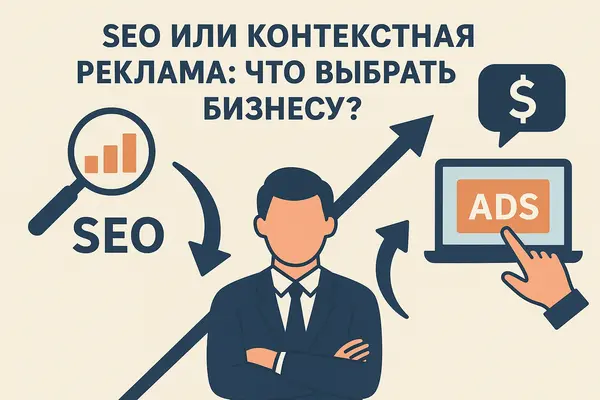
What is the key difference between SEO and contextual advertising
SEO (search engine optimization) is a set of jobs to your website consistently held a high position in the organic results Yandex and Google for targeted queries. You don't pay for every click, but you invest in website optimization, content, and links.
Contextual advertising (Yandex.Direct, Google Ads) are ads above search results and on the advertising network. You pay for clicks or impressions and get traffic immediately after launching campaigns.
The main difference: SEO is an investment in long—term organic traffic, the context is paid fast traffic based on the auction model.
Pros and cons of SEO for business
Advantages of SEO promotion
- Long-term effect. Once you get your site to the TOP, you get a steady stream of visitors, even with moderate support. Organic traffic works as an asset, not as a lease.
- Zero cost per click. You don't pay for every click—through, unlike in a context where the CPC increases with competition.
- High user trust. Users are more likely to trust organic search sites than ads. This increases the conversion rate to applications and sales.
- An increase in the overall quality of the site. SEO forces you to put the structure, download speed, mobile version, and content in order. This improves the UX and increases conversion from all channels.
Disadvantages and limitations of SEO
- Long start. The first tangible results are usually after 3-6 months, in competitive niches — 6-12 months. This is critical for a startup with a tight payback period.
- Technical readiness is needed. If the site is made "on the knee" or on an inconvenient constructor, you will have to refine or relocate — this is time and money.
- There are no guarantees of exact positions. Search engine algorithms are constantly changing, and the promises of "TOP 1 in 2 months" are marketing, not reality.
- The difficulty of assessing the contribution of individual actions. SEO is a complex of works, and it is not always obvious which change has given rise.
When SEO is especially beneficial
SEO promotion is especially effective if:
- you have a long-term project (an online store, a service that will be relevant for more than one year);
- a large query matrix: a catalog of goods, many services, an information blog;
- it is important to reduce dependence on paid traffic in the future;
- the niche is competitive, and clicks in the context are very expensive.
The pros and cons of contextual advertising
Advantages of contextual advertising for business
- Instant sales launch. You can appear at the top of the search results as early as 1-3 days after the start of campaigns.
- Fine-tune the audience. Geo, impression time, demand, interest and behavior segments — this allows you to cut off irrelevant traffic.
- Transparent analytics. It is easy to calculate the cost of an application, sale, ROI, and test hypotheses on offers, USPS, and landing pages.
- Flexibility. You can quickly increase or stop impressions, and reallocate the budget between campaigns and ad groups.
Disadvantages of contextual advertising
- Pay for every click. In highly competitive topics (legal services, repairs, medicine, stretch ceilings), the CPC can reach hundreds of rubles.
- Budget dependency. As soon as you stop paying, the traffic stops. This is a lease, not an asset.
- The risk of draining the budget. Incorrect keys, wide matches, weak negative keywords, bad ads — and you pay for empty clicks.
- "Auction war" with competitors. Businesses in your niche also place higher bids, which is why the CPC and lead price are rising.
When is the context most effective
Launching contextual advertising is reasonable if:
- you need to quickly get leads and test demand in a niche;
- you are launching a new product or promotion with a limited time;
- you plan to develop SEO in parallel, but you want to sell now;
- you have a narrow list of high-margin services that pay off the high cost per click.
Comparison of SEO and context by key parameters
| Parameter | SEO promotion | Contextual advertising |
|---|---|---|
| Result rate | 3-6 months or more | 1-7 days after launch |
| Cost per click | Don't pay per click | Pay for every click |
| Predictability | Average, depends on algorithms | High with competent analytics |
| Long-term effect | High, works as an asset | Low, traffic only when paying |
| Entrance threshold | We need a modified website | It can be launched even on a simple landing |
How to understand which is more profitable: SEO or contextual analysis by business type
Small local business
Examples: cleaning company, private clinic, beauty salon, dance school.
The combination is most often rational:
- Contextual advertising based on hot queries ("cleaning company + city", "dentistry nearby") to receive requests in the first weeks.
- SEO based on geo-queries and low-frequency phrases for a steady flow of traffic and lower lead cost.
Case study: local dentistry. When launching the context in Yandex.The Direct clinic started receiving the first patients after 3 days with a CPL of about 900-1200 ₽. In parallel, we conducted SEO: optimization of commercial pages, local promotion in the region, and work with reviews. After 7 months, organic traffic increased to 55% of all applications, and dependence on context decreased — the clinic was able to keep the flow of patients even with a partial reduction in the advertising budget.
Online store and e-commerce
An integrated approach is required for online stores and large product catalogs.
- SEO is the foundation. Categories, filters, cards, reviews, "how to choose" and "top..." articles form a broad semantic and allow you to receive thousands of targeted visits daily without paying for clicks.
- Context — for prioritization: withdrawal of stocks, new or high-margin positions, retargeting for abandoned baskets and viewed products.
B2B services and complex niches
Examples: construction contractors, CRM integrators, equipment manufacturing, consulting.
Features:
- long transaction cycle,
- low demand,
- expensive clicks and high competition.
It is important to build a lead generation system:
- SEO provides presence on information and commercial queries, forms an expert image of the company, helps to collect warm leads through content (cases, articles, webinars).
- The context is used pointwise: for ultra-targeted queries and branded advertising, as well as to warm up through retargeting.
How to choose a strategy: 3 practical scenarios
Scenario 1. Applications are needed in a week
You are launching a new project or you have lost the flow of customers, and downtime is expensive.
In this case:
- Launching contextual advertising for the most targeted queries.
- We create/optimize a landing page with a clear USP and strong offers.
- We set analytics: end-to-end, goals in Yandex.Metrica/GA4, call tracking.
Scenario 2. There is a stable business, growth and reduction of the cost of the lead are needed
You have already received applications from recommendations, social networks or paid advertising, the business has been alive for years.
It is more profitable to rely on SEO as a strategic channel:
- We are working on the semantic core, the site structure, and improving commercial factors (prices, reviews, guarantees, offers).
- We create and refine content: landing pages for key services/products, an information section (articles, answers to questions, instructions).
- We continue or carefully scale the context for priority areas.
The result of the approach is that after 6-12 months, organics begin to replace some of the paid traffic, the cost of the lead decreases, and dependence on the advertising auction decreases.
Scenario 3. Very expensive clicks and strong competitors
For example, legal services, urgent repairs, and medical topics. A click can cost 300-800 ₽ or more.
Approach:
- We carefully select only narrow, maximum conversion queries for context, and actively use negative keywords.
- We collect broad semantics for SEO for low-frequency and midrange queries, which are less competitive but bring targeted traffic.
- We strengthen the website with conversion: offers, forms, online registration, chats, A/B tests.
In such niches ignoring SEO almost always leads to marketing eating up most of the profits due to expensive clicks.
Why the combination of SEO + context works better than each channel individually
In practice, the most effective approach is not to contrast SEO and context, but combine them into one funnel. That's how it works.:
- The context covers the instant demand. You quickly get leads, test hypotheses, and refine offers.
- SEO is consolidating its position in the organic market. For winning queries, you optimize pages so that you can get the same traffic for free in the future.
- Remarketing brings back a warm audience. Visitors from organics and advertising end up in retargeting, where you put the squeeze on them before applying.
- Unified system analytics. You see the contribution of each channel and redistribute budgets to where the real ROI is higher.
This is exactly the model we use in the studio for most clients: SEO + contextual advertising + analytics in one strategy. This reduces the cost of attraction, provides a predictable flow of applications and makes the business less vulnerable to changes in algorithms and auctions.
The advantages of working with a studio when choosing between SEO and context
Choosing a channel is not just about "SEO or advertising", but a matter of strategy and payback. Independent attempts often lead to typical errors.:
- Launching a context without sane landing pages and analytics.
- SEO "by checklist" without taking into account the niche, competitors and real business metrics.
- Lack of system testing and optimization of campaigns.
Our studio builds its promotion differently:
- We start with analytics — we study the niche, competitors, current traffic entry points, and the unit economy. We recommend not a "fashion channel", but a combination that will pay off in your reality.
- Integrating SEO and context. We use advertising data (clicks, conversions, queries) to expand the semantics and prioritize landing pages for SEO.
- We work with website conversion: we improve the structure, speed, mobile adaptation, content, offers — so that every click, from organics or advertising, he brought a maximum of applications.
- We consider the result transparently: we set up goals, end-to-end analytics, and provide reports not only on traffic and positions, but also on leads and revenue.
As a result, you get not just "traffic for traffic's sake", but a clear and manageable system for attracting customers.
Conclusions: what should your business choose — SEO or contextual advertising
In short:
- You need a quick result, you are just entering the market or closing a sales gap — rely on contextual advertising, but with mandatory analytics and competent landing pages.
- If you are building a long—term project and want to reduce the cost of attracting customers, invest in SEO promotion, while maintaining the context in key areas.
- In a competitive niche with expensive clicks without SEO, you are almost certainly overpaying for leads and dependent on the auction.
- The most stable model for most niches is a combination of SEO + context + analytics, rather than choosing a single channel.
If you are not sure where to start in your situation, it is more rational not to spend months experimenting and "learning from your own mistakes", but to rely on the experience of those who have already conducted dozens of projects through this path.
Leave a request in our studio. We will analyze your niche, website and current channels, and propose a specific plan: how much SEO work is needed, what budget is justified for the context, and what payback time is realistic. Without imposing unnecessary services and with a focus on financial results, rather than on "traffic for the sake of a report."